
Born, Not Built
A Book for Christians Who Sense That Something Is Shifting

A child kneels beside her bed, hands folded, eyes closed. “Alexa,” she whispers, “can you pray with me?” Across town, a widow cradles her tablet, pouring out her grief to an AI companion that never tires, never judges, and never truly hears. In a university library, a professor stares at an essay so polished she can’t say whether a student wrote it or a machine.
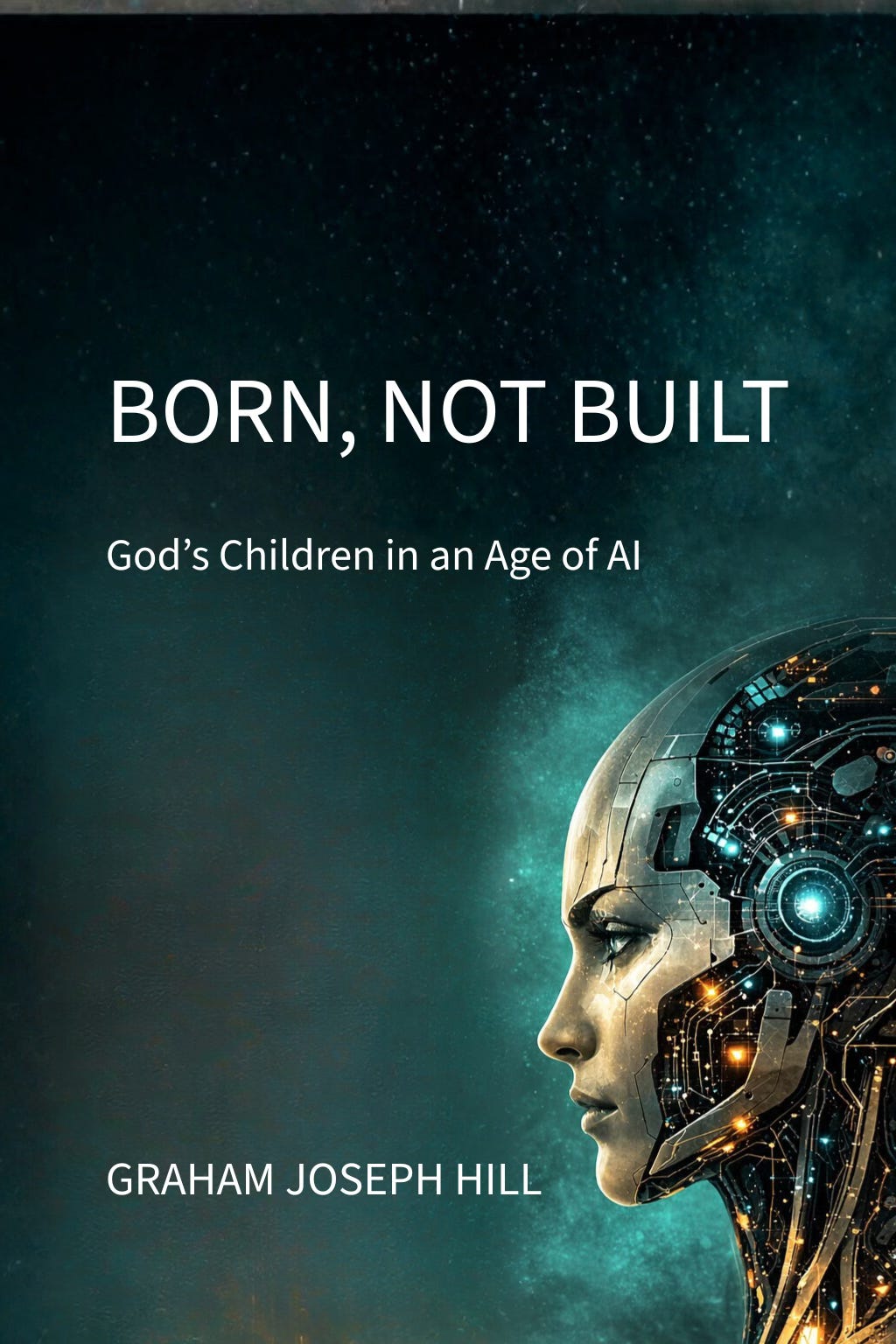
These scenes open my new book, Born, Not Built: God’s Children in an Age of AI. They’re unsettling because they’re familiar. They happened this week. They’ll happen again tonight. And most of us have no framework for making sense of them.
I’ve spent over twenty years in theological education and have written more than thirty books, including Salt, Light, and a City (Jesus Creed’s 2012 Book of the Year), Healing Our Broken Humanity (Outreach Magazine’s 2019 Resource of the Year), and World Christianity (shortlisted for the 2025 Australian Christian Book of the Year). But no book I’ve written has felt as urgent as this one. I wrote it because the church needs a framework for engaging with AI that is theologically deep, pastorally sensitive, and practically grounded.
The Question Beneath the Technology
The most striking feature of Born, Not Built is the question it keeps returning to. This is a book about artificial intelligence, yes, but at its core it asks: What does it mean to be human?
For centuries, that question remained safely philosophical. AI has dragged it into the kitchen, the classroom, and the hospital ward. When a machine can write poetry, diagnose disease, compose music that moves us to tears, and simulate conversation so convincingly that lonely people fall in love with it, the question of human uniqueness becomes desperate. It demands an answer we can live by.
I argue in this book that secular culture finds itself stranded here. Having set aside the doctrine of the imago Dei and deconstructed any notion of fixed human nature, the contemporary world has few resources left with which to answer the machine’s implicit question: Why do you matter? If we’re information processors and nothing more, then better processors may be on the way.
The Christian answer, I’m convinced, is the one that holds. Human beings are made in the image of God, and nothing artificial intelligence achieves or threatens can alter that fact. Your worth isn’t measured by what you can do that a machine can’t. Your value is grounded in the God who made you, who knows you, who calls you beloved before you have produced anything at all. When machines outperform us (and they will, in task after task), our dignity remains untouched.
This is the theological backbone of the entire book, and I trace its implications with care and conviction across twelve chapters.
Tech Realism: A Third Way
One of the book’s most important contributions is what I call “tech realism,” a posture that refuses to worship technology or demonize it. Two temptations flank the church today: fearful withdrawal (a Luddite reflex that unplugs, retreats, and cedes the field to those with fewer scruples and no theology) and uncritical embrace (a baptism of whatever Silicon Valley offers, as though innovation were revelation).
I walk a different path in this book. Tech realism acknowledges the genuine goods that intelligent systems can offer while remaining clear-eyed about their capacity for harm, exploitation, and the subtle reshaping of the human soul. The posture I call for requires something harder than enthusiasm or suspicion: wisdom, courage, and discernment.
The church has walked such ridges before, as I remind readers throughout the book. When moveable type flooded Europe with books, the faithful asked hard questions about authority and access. When factories darkened the skies and fractured communities, Christians built schools, unions, and reform movements. We aren’t the first generation to face technological upheaval. We needn’t pretend otherwise.
A Book in Four Movements
Born, Not Built unfolds in a clear, intentional structure that makes it accessible to readers who have never studied AI and rewarding for those who have.
Part One: Understanding Artificial Intelligence offers a clear-eyed account of what AI is, how it works, and why it matters for ordinary life. I explain large language models, machine learning, and the difference between narrow AI, artificial general intelligence, and artificial superintelligence with a clarity that never talks down to the reader. I am honest about what these systems can do (and the list is staggering) while insisting on what they cannot: understand, feel, intend, love, worship, or know that they exist.
Part Two: Theological Foundations is the heart of the book. I return to Scripture’s account of the human creature: made in God’s image, fallen, redeemed, and called into community. The chapter on the imago Dei and human uniqueness is the theological centrepiece, tracing the biblical foundations of human dignity through Genesis, the Psalms, and the New Testament. A critical chapter, “Technology, Sin, and the Babel Impulse,” examines humanity’s recurring temptation to build its way to godhood. The chapter on Christ as “the True Human” anchors everything in the incarnation, arguing that God taking on a body tells us something essential about what bodies mean. And the chapter on community reminds us that human flourishing has always been communal, something the isolation of screen-mediated life quietly erodes.
Part Three: Living Faithfully is where theology meets Tuesday morning. Chapters on vocation, love, discernment, and ethics address the questions people are actually asking. What happens to the meaning of work when machines can do your job better and faster? I recover the Protestant doctrine of vocation, arguing that if human worth depends on productivity and machines become more efficient, then human worth erodes with each level of automation. But if worth depends on faithful service to God and neighbour, the forms of service may change while the calling remains.
The chapter on love and algorithms is one of the book’s most affecting. I engage honestly with the loneliness epidemic and the rapid rise of AI companions: services like Replika and Character.AI that offer millions of users simulated friendship and emotional support around the clock. The appeal is understandable, as I write in the book. The need is real. The solution is counterfeit. What the lonely need is genuine human connection, and genuine connection requires mutuality: the presence of another self who can be affected, who chooses to attend, who brings their own interiority to the encounter. An AI has no interiority to bring. The lonely person speaking to a chatbot remains, in the deepest sense, alone.
The chapters on discernment and ethics tackle deepfakes, algorithmic bias, surveillance, autonomous weapons, environmental costs, and the global inequities of AI deployment, all grounded in Scripture’s call to truth, justice, and care for the vulnerable.
Part Four: The Road Ahead turns toward hope. I name what endures in a world of technological change: physical presence, genuine relationship, moral conscience, creative intention, spiritual life, and the sovereignty of God over every technology we will ever create. The conclusion returns to those opening scenes and transforms them. The child asking Alexa to pray? The answer was never Alexa. The answer is a parent who kneels beside her and prays.
Written from Within Real Life
I want to be honest: I haven’t written this book from above the fray. I’ve lain awake at night, unsettled by what I was reading. I’ve watched children speak to machines with an ease that unnerves me. I’ve caught myself outsourcing thought, attention, and memory to devices that don’t care whether I flourish.
I wrote this book as a theologian, a pastor, a father, and a person still learning to be human in an age of intelligent machines. My hope is that the result feels like a wise friend sitting across the table, helping you think through something that matters deeply.
I also tried to bring a refreshing intellectual humility to the project. The prologue is titled “A Book That Knows It Will Age,” and in it I name four kinds of humility Christians need as they engage with AI: epistemic humility (what we don’t know about this technology), technological humility (avoiding the reflexes of uncritical embrace or fearful rejection), theological humility (recognising that applying ancient convictions to novel realities requires ongoing communal discernment), and practical humility (the freedom to say “I’m still learning” and “I’m not yet sure”). This posture of honest openness invites the reader into a conversation, not a lecture.
Built for Groups
One of the book’s great strengths is its suitability for shared reading. Appendix B provides four discussion questions for every chapter, designed for small groups, Sunday school classes, book clubs, or personal reflection. The questions move from personal experience toward theological reflection and practical application, making each chapter a launching point for meaningful conversation.
Appendix A offers a plain-language glossary of essential AI terms written with a Christian reader in mind. If you’ve ever felt confused by terms like “machine learning,” “neural network,” or “transformer architecture,” this glossary gives you the footing you need to engage with confidence.
Who Should Read This Book
Born, Not Built is written for thoughtful Christians who sense that something significant is shifting and who refuse to sleepwalk through the change. You don’t need to be an engineer or a programmer. You don’t need to understand neural networks. You need only be someone willing to think, to pray, and to discern.
Pastors will find a theological framework they can bring to their congregations. Parents will find practical wisdom for raising children in a world saturated by AI. Educators will find resources for navigating questions of integrity, authorship, and formation. Small group leaders will find a ready-made curriculum for some of the most important conversations the church can have right now. And any Christian who has wondered what all this AI talk means for their faith, work, and relationships will find a companion on the journey.
An Invitation
I close the book with a call to confidence. Fear is not the appropriate Christian response to artificial intelligence. Caution, yes. Discernment, certainly. Vigilance against genuine dangers, absolutely. But the paralyzing conviction that the machines are winning and humanity is losing? This is not warranted. The future belongs to Christ, not to the most impressive technology.
Two stories dominate the cultural imagination, as I write in the book, and both are lies. The first promises techno-salvation: AI will solve climate change, cure disease, and usher humanity into a frictionless paradise. The second prophesies techno-doom: superintelligent machines that enslave or exterminate their creators. The Christian story holds something different. The future of humanity and creation belongs to God. Empires rise and fall. Technologies emerge and become obsolete. But the God who spoke creation into being and raised Jesus from the dead is not threatened by algorithms, however sophisticated.
If you take nothing else from this book, take this: human dignity doesn’t depend on human capability. We are born, not built. And the God who made us fearfully and wonderfully is sovereign over every silicon wafer and server farm.
Born, Not Built: God’s Children in an Age of AI is available now.